Archives
-

Educab-Revista de Educación
Vol. 1 No. 17 (2026)We are pleased to present the seventeenth issue of Educab-Journal of Education. Reaching this issue is a source of pride for our team, and it also recognizes the space this journal has gradually carved out for itself within the ecosystem of peer-reviewed publications in Venezuela and Latin America. This effort takes on even greater significance in 2026. We began this year with upheavals, reverberations, and shifts in the configuration of the political system, with foreseeable effects yet to be fully assessed on the education system. Just as this reality was being assimilated into society, nature struck with the earthquakes of June 24th, causing profound damage in Vargas state and other parts of the country, resulting, according to UNICEF Venezuela, in the destruction of 437 schools nationwide. This number of schools represents more than 157,000 children and adolescents without a place to begin the 2026-2027 school year, as well as more than 7,000 teachers without a space to carry out their pedagogical practice.
This clearly demonstrates the need to sustain the commitment, effort, continuity, and dedication of the Venezuelan academic community in the field of educational sciences, especially during this time of worsening complex humanitarian emergency declared in the country in 2019. The year 2026 requires a thorough understanding of the concept of education in emergency contexts. It reaffirms that educating and being educated are highly complex processes to organize, practice, and evaluate, a complexity that extends to their study. Therefore, interdisciplinary work is the way to build new paths toward consolidating the quality of education, with the added benefit of developing it in unconventional spaces, particularly those serving Venezuelans who have lost everything and are left with only their lives.
That said, this issue was being finalized in the context of the June 24th earthquakes. Therefore, it features articles more closely associated with proposing and describing experiences of change bordering on innovation—precisely those necessary transformations that directly impact pedagogical practice, in order to understand it from an innovative perspective. We can find three sections in this seventeenth issue: AI in education, educational policies, and successful experiences of innovation in educational processes.
It is always worth remembering that this issue of Educab would not have been possible without the important contribution and insights of the reviewers and the Editorial Board. We also want to extend our gratitude to the Research Secretariat and the AB Ediciones UCAB Management for their work in producing this issue. We hope that this journal will encourage debate, analysis, and the consideration of new proposals in the educational field, which is ultimately Educab's central objective.
-

Educab-Revista de Educación
Vol. 1 No. 16 (2025)We are pleased to present the sixteenth issue of Educab-Journal of Education. Reaching this issue is a source of pride for our team, and it also reflects the growing recognition this journal has gradually earned within the ecosystem of peer-reviewed publications in Venezuela and Latin America. This clearly demonstrates the commitment, effort, continuity, and dedication of the Venezuelan academic community in the field of educational sciences, as well as colleagues from other disciplines who approach the study, research, analysis, and reflection on education. It is clear that educating and being educated are highly complex processes to organize, practice, and evaluate, a complexity that extends to their study. Therefore, interdisciplinary work is essential for building new paths toward consolidating quality education.
With that in mind, this issue features articles more closely associated with proposing and describing experiences of change that approach innovation—precisely those necessary transformations that directly impact pedagogical practice—in order to understand it from an innovative perspective. The work entitled "Theoretical Foundations of the Application of Web 3.0 Tools in Education" demonstrates that these tools foster active and collaborative learning, where students become protagonists of their own process, especially with the integration of blockchain technology, which facilitates addressing persistent challenges in educational processes. Following this line of thought, the article "Understanding Generative AI in Educational Environments" reveals that currently there is no conceptual framework for evaluating these technologies, leading to uncertainty among educators when selecting appropriate tools. This research proposes a domain model that articulates the relationships between quality assessment, meaningful teaching strategies, and GAI tools, using documentary methodology and the Unified Modeling Language (UML) to visually represent these interactions.
Without abandoning the space of pedagogical invocation based on technology, the article "Digital Alternatives to Promote the Inclusion and Integration of Children on the Autism Spectrum" analyzes digital tools that contribute to establishing better physical and psycho-emotional conditions for teachers, who are responsible for the integration of neurodiverse students. Therefore, its authors present a series of recommendations that go beyond the digital realm, hoping to align with more recent approaches to psychological development, helping families and schools better support their students and their families.
Now, transcending the digital world, this issue presents three works that address the development of best practices for pedagogical transformation, with a focus on higher quality education. The research supporting the article "Transformative Teaching: Best Practices in Times of Pandemic" analyzed best teaching practices during the 2021-2022 academic year at the Catholic University of Táchira. Their findings indicate that technology reduces learning gaps, ensuring that a large majority of students had access to conceptual, procedural, and attitudinal learning. Meanwhile, the article "Audiovisual Media as a Tool for Teaching Philosophy" advanced the systematization and analysis of the relationship between teaching philosophy and audiovisual media, a key aspect of the Fourth Industrial Revolution. This research proposed a two-pronged study: the first considers the resistance to adapting to and understanding audiovisual media among teachers; the second involves digital natives, who exhibit a rejection of traditional teaching methodologies. Finally, the work developed in Historical Painting, a Meeting Point for Learning employs Universal Design for Learning (UDL), a pedagogical framework that attempts to eliminate obstacles in the learning process, based on the recognition of the variety of learners' needs, in the teaching of Venezuelan history through the analysis of historical painting, specifically works by Juan Lovera and Tito Salas, with the intention of facilitating a better understanding of past events.
As with every issue of Educab-Journal of Education, we present a Teaching Experience, entitled "The History Olympics: A Successful Experience in the Teaching and Learning Processes of Venezuelan History." It recounts the reality of a program aimed at schools in low-income communities, with the goal of improving pedagogical mediation in the teaching of History as a means of fostering citizenship and democratic awareness among 5th and 6th grade primary school students.
It is always worth remembering that this issue of Educab would not have been possible without the important contribution and perspective of the reviewers and the Editorial Board. We also extend our gratitude to the Research Secretariat and the AB Ediciones UCAB Management for their work in producing this issue. We hope that this journal will encourage debate, analysis, and the consideration of new proposals in the field of education, which is, ultimately, Educab's central objective.
-
Educab-Revista de Educación
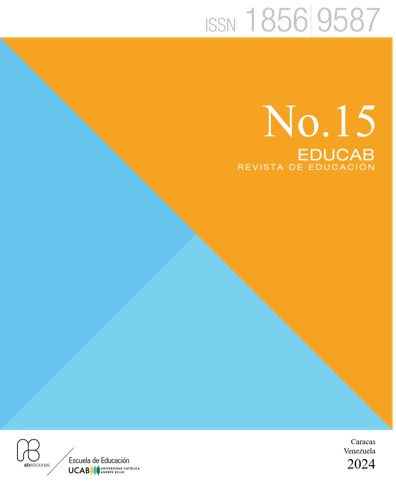
Vol. 1 No. 15 (2024)En este año 2024 Educab-Revista de Educación llega a sus primeros quince números que, al ser una publicación de carácter anual, implica también los primeros quince años de existencia. Culturalmente, quince años implican la transición de la infancia extendida a la primera juventud, esa misma en la que aún somos adolescentes pero comenzamos a tener ideas un poco más claras de lo que queremos ser de mayores. Aunque este paralelismo siempre nos ayuda a recordar quiénes somos, de dónde venimos y hasta dónde queremos llegar, justamente este quinceavo número es una ocasión para recordar a todos y cada uno que, directamente o indirectamente, han estado vinculados con Educab, así como un llamado a la valoración, reflexión y apuesta por seguir madurando en todo aquello que implica dar el lugar que la educación y la investigación aplicada en nuestra área se merece.
No sería justo dejar de mencionar en esta ocasión a nuestra primera Directora, La Dra. Lucía Raynero Morales, quien construyó las bases de esta revista, a partir de una muy añeja aspiración de la Escuela de Educación por generar su propia publicación arbitrada e indexada. Su estilo y su forma de hacer las cosas dejaron impronta y carácter a esta publicación. También vale la mención a la Prof. Lisset Michinel Portos, quien con su juventud y su pasión por la ciencia bien hecha, también precisó un estilo y forma de continuidad en el carácter y calidad de Educab-Revista de Educación.
Este número viene cargado de temas propios de esta era. Lejos ya nos queda la preocupación por la educación remota de emergencia y sus diversas expresiones en lo didáctico, lo curricular y lo evaluativo que ocuparon más de un número de esta revista. Como podrán verificar a lo largo de los contenidos, arbitrados y evaluados para este número quince, el tema dominante es la Inteligencia Artificial y las expresiones que los autores han podido encontrar en el ámbito pedagógico. Los trabajos presentados Soledad y Adames, López Echeverría y Labrador nos proponen un viaje sobre las diversas aristas en las que se pueden asumir integración de la Inteligencia Artificial como un medio instruccional más, totalmente naturalizado en el contexto general de la práctica pedagógica. Ahora bien, el trabajo de Puche nos ofrece un marco general, funcional a la interpretación que corresponde en esta era sobre las competencias digitales y la producción científica. Por ello lo tecnológico, lo digital y la Inteligencia Artificial emergen como el campo dominante de este número.
Sin embargo, Educab-Revista de Educación no puede dejar nunca de lado su compromiso en la construcción de propuesta pertinentes viables asociadas al sistema educativo venezolano como un todo. Los trabajos presentados por Affigne, Vélez Sánchez y Sulbarán marcan acentos en problemáticas propias del sistema educativo, con mayor preocupación en el contexto general de nuestro país y la región en la que estamos enclavados.
Al mismo tiempo, el número quince se viste de gala con la primera contribución que nos hacen llegar desde la Escuela de Arquitectura de la UCAB. El trabajo de Villota aborda un tema central en la formación de los Arquitectos, la Biografía Proyectual en la Arquitectura Orgánica. Nos honra ser altavoz de una metodología, una forma de comprender y hacer en un campo naciente en nuestra Universidad que encuentra en Educab-Revista de Educación un altavoz para avanzar en aquello que educativamente podemos calificar como didáctica de la arquitectura.
Tal como se ha referido en ocasiones anteriores, este número de Educab no hubiera sido posible sin la importante contribución y mirada de los árbitros y del Consejo Editorial. También, queremos extender nuestro agradecimiento al Secretariado de Investigación y a la Dirección de AB Ediciones UCAB en la generación de este ejemplar. Esperamos que esta revista invite al debate, al análisis y a la consideración de nuevas propuestas en el ámbito educativo, que al final de cuentas es el objetivo central de Educab.
-
Educab
Vol. 1 No. 14 (2023)Nos complace publicar el número catorce de Educab, Revista de Educación publicación arbitrada de la Escuela de Educación de la UCAB. Este número nace en uno de los peores períodos escolares del sistema educativo venezolano, aún sin recuperarse totalmente de los efectos de casi dos años de clases remotas consecuencia de la pandemia de la COVID-19, así como la profundización y persistencia de la emergencia humanitaria compleja en Venezuela que, en términos más exactos, sólo demuestra la condición terminal de la crisis del modelo de gestión de los niveles obligatorios ajustados a una visión excluyente de la tesis del Estado Docente.
Esta presentación no pretende ser una alegoría del colapso. Más bien, este número catorce sale de la venezolana tradición de reiterar constantemente en el diagnóstico del caos para -justamente- avanzar hacia los propositivo, la construcción de lo posible. Cada uno de los artículos aquí presentados, esperan iluminar desde diversas perspectivas nuevas formas de aceptar, asumir e interpretar el hecho educativo en Venezuela, así como la apuesta decidida por avanzar en nuevas formas de construcción de consensos que desemboquen en planes, programas, proyectos que incidan en políticas educativas cada más pertinentes no sólo con la realidad cierta de los tiempos que vivimos, sino del destino que la Nación se merece en su avance hacia la redemocratización de su tejido social y la regeneración de su sistema educativo.
Los invitamos no sólo a leer, sino a utilizar los trabajos que conforman este número catorce. Son textos de valor que esperan ir más allá de la proposición, pretenden constituirse en documentos que animen el debate, la discusión y la reflexión crítica que tanto exige la escuela venezolana en el resurgimiento a partir de sus cenizas.
Como siempre, reiteramos nuestro agradecimiento a los autores, al grupo de árbitros, al equipo de profesores a dedicación de la Escuela, así como a todo el Consejo Editorial y AB Ediciones Publicaciones UCAB por todo su trabajo, por cada uno de sus aportes que permitieron la existencia de este número.
-
Educab Revista de Educación
Vol. 1 No. 13 (2022)